The 8 Best Claude Alternatives in 2026 (Chat, Code and Cowork)
You almost certainly did not come here because Claude writes badly. You came here because you hit a wall — a weekly limit you could not see coming, no image generation, no live web data, or a $200 plan that still ran dry on a Thursday afternoon.
So this guide is organised around walls rather than features. Chat assistants first, then what to use instead of Claude Code, then the Cowork-style agents. Every price came off the vendor own page in August 2026, and we tell you which free tiers are genuinely usable rather than just present.
Where Claude is still the better tool — and on measured quality it often is — we will say so rather than sell you a switch you do not need.
Images, voice, Codex and ChatGPT Work in one subscription, and the free tier gives you unlimited text chats. If your complaint is a missing feature rather than answer quality, this is a one-step fix.
Free tier: Unlimited text chats, plus Work and Codex on the desktop app.
Free / $8 (Go) / $20 per mo
02
Google Gemini
You get storage thrown in
Google sells AI attached to cloud storage, so $4.99 buys you 400GB as well. Nobody else bundles anything. You will notice the drop on long documents and careful reasoning.
Free tier: Free tier includes image generation, Deep Research and 15GB.
Claude weakest axis is current information with links attached, and that is Perplexity whole product. Do check the citations — independent studies found roughly a third miss.
Free tier: Free tier with limited Pro searches.
Free / $20 per mo ($10 education)
04
Grok
Live data and the loosest guardrails
Real-time X and web access, a 500K-token context window, and image plus video generation. Less filtered than anything else here, which will suit you or it will not.
Free tier: Free tier on grok.com and in X, rate limited.
Free / from $30 per mo
05
DeepSeek
The cost floor
MIT-licensed weights mean you can run V4 yourself, and the API sits about a tenth of frontier pricing. Capability is not the objection here — where your data goes might be.
Free tier: Chat app is free; API is close to free off-peak.
Free chat / API from $0.22 per M tokens
06
Mistral Le Chat
If the objection is jurisdictional
European company, open-weight models you can self-host, and the only free tier that hands you $10 a month of API credits. Behind Claude on the genuinely hard reasoning.
Free tier: Free tier including $10 per mo in API credits.
Free / $14.99 per mo
07
Microsoft Copilot
Lives inside your documents
If your work happens in Word, Excel, Outlook and Teams, this edits the actual files rather than giving you text to paste. Same bundling trick as Google, different stack.
Free tier: Copilot Chat is free if you already have Microsoft 365.
Free / from $18 per user per mo
08
Kimi
For when nothing else will swallow the document
A million-token context window and a capable coding variant. Worth a look if your actual complaint is that Claude will not take the whole corpus in one go.
Free tier: Free tier available.
Free / paid API tiers
Claude alternatives compared at a glance8 tools
#
Tool
Best for
Free tier
Price
01
ChatGPT
Fixes what Claude simply cannot do
Free tier
Free / $8 (Go) / $20 per mo
02
Google Gemini
You get storage thrown in
Free tier
Free / from $4.99 per mo
03
Perplexity
When you need a source, not a summary
Free tier
Free / $20 per mo ($10 education)
04
Grok
Live data and the loosest guardrails
Free tier
Free / from $30 per mo
05
DeepSeek
The cost floor
Free tier
Free chat / API from $0.22 per M tokens
06
Mistral Le Chat
If the objection is jurisdictional
Free tier
Free / $14.99 per mo
07
Microsoft Copilot
Lives inside your documents
Free tier
Free / from $18 per user per mo
08
Kimi
For when nothing else will swallow the document
Free tier
Free / paid API tiers
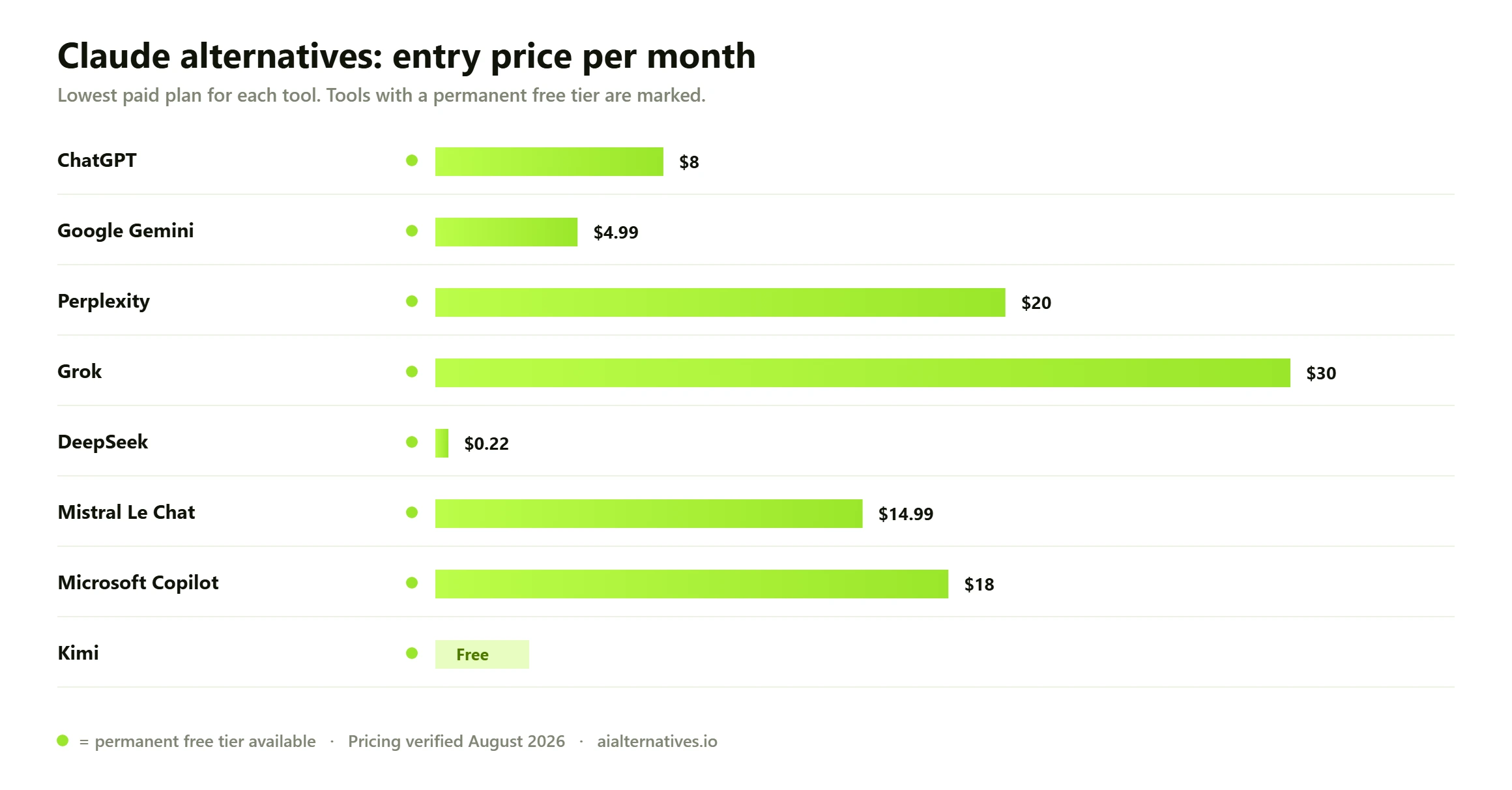
Entry monthly price across every Claude alternative we tested. Green dot marks a permanent free tier. Pricing verified August 2026.
Why you might be looking
Let us be straight about this: Claude is very good. Anthropic holds six of the top ten places on the Arena leaderboard and the highest score on the Artificial Analysis Intelligence Index. If you are unhappy, it is probably not the answers.
It is one of four things, and three of them are about limits rather than quality.
The weekly limit you cannot see
Anthropic added weekly caps for Pro and Max in August 2025, saying they would affect fewer than 5% of subscribers. Reporting at the time put Max 20x at roughly 240 to 480 hours of Sonnet and 24 to 40 hours of Opus a week. Then in March 2026 the five-hour session limits tightened during peak hours, which Anthropic said newly caught around 7% of users.
In June 2026 a proposed class action was filed on behalf of Max subscribers, arguing that the advertised 5x and 20x multipliers collapse under weekly caps nobody was shown — it cites a single five-hour session eating 15% of a weekly quota. The case is unresolved and the allegations are untested, so treat it as context rather than fact.
The structural bit is simpler and it is on Anthropic own pricing page: your terminal work and your chats come out of one pool. Push hard on Claude Code on Tuesday and you will find your writing rationed on Thursday. If that is your situation specifically, jump to our Claude Code alternatives guide, which handles the terminal side properly.
No images, no live web, no weights
Claude cannot generate an image on any plan. ChatGPT, Gemini and Grok all can, and Grok does video. Claude web search is real but it is not a research engine the way Perplexity is. And there are no open weights, so running it on your own hardware is not on the table — unlike DeepSeek V4 or Mistral open models.
None of these is a flaw exactly. They are decisions. But if one of them sits in the middle of your workflow, no amount of writing quality compensates.
Cowork sits behind a paywall its rival does not
Anthropic launched Claude Cowork in January 2026 and brought it to mobile and web in July. Its own data from 1.2 million sessions in May is telling: 33.4% business process work, 16.4% content creation, only 8.7% software development. It is an office tool that happens to be built on a coding agent.
OpenAI shipped ChatGPT Work on 9 July 2026 as a direct competitor and put it in the desktop app for everyone, free accounts included. Cowork stays paid-only. If you are evaluating agents for a team, that contrast is the sharpest thing on this page.
What the alternatives cost you
Everything below was read from the vendor own page in August 2026. For reference, Claude Pro is $20 a month or $17 billed annually, Max runs $100 and $200, and Team is $25 a seat or $20 annually.
Tool
Best for
Entry price
Free tier
ChatGPT
Widest feature set
$8 (Go) / $20 (Plus)
Yes, unlimited text chats
Google Gemini
Cheapest paid, storage included
$4.99 per mo
Yes, includes image gen
Perplexity
Cited live research
$20 per mo ($10 edu)
Yes, limited Pro searches
Grok
Real time, 500K context
$30 per mo
Yes, rate limited
DeepSeek
Lowest cost, self-hostable
Free chat / API usage
Yes, MIT weights
Mistral Le Chat
EU data residency
$14.99 per mo
Yes, plus $10 API credits
Microsoft Copilot
Microsoft 365 work
$18 per user per mo
Copilot Chat free for M365
Kimi
Million-token documents
Paid API tiers
Yes
Claude
Writing, analysis, coding
$17 per mo (annual)
Yes, capped
The ones worth your time, reviewed
1. ChatGPT — the one that fills the gaps
If what bothers you is a missing capability rather than the quality of an answer, this fixes it in one move. Images, voice, Codex, scheduled tasks, custom GPTs and ChatGPT Work all sit inside one subscription, and the connected-app ecosystem is the biggest in the category.
Prices as of August 2026: Free, Go at $8, Plus at $20, Pro at $100 or $200 depending on the multiplier, Business at $25 a seat or $20 billed annually. Go at $8 is the one to notice — it undercuts Claude Pro by 60% and handles most everyday work comfortably.
What you will miss is a certain steadiness in long-form writing and long-document analysis, where Claude is still the better instrument. If you are weighing the move in the other direction, our ChatGPT alternatives guide covers it.
2. Google Gemini — you are buying storage, and AI comes free
Look at what your money actually buys. AI Plus is $4.99 a month with 400GB. AI Pro is $19.99 with 5TB. Claude Pro is $17 to $20 and gives you no storage at all.
If you were going to pay for cloud storage anyway, Gemini is close to free and the decision makes itself. If you were not, you are buying storage you did not want. The free tier is genuinely good too — image generation and editing, Deep Research, 15GB. On measured reasoning it trails Claude on both leaderboards, so this is a value call rather than a quality one.
3. Perplexity — when the answer needs a link behind it
Reach for this when your output has to be checkable. Pro is $20 a month, Max is $200, and there is a $10 education tier with student verification that almost nobody writes about — worth knowing if you qualify.
One caveat to carry with you: independent studies of AI search citation accuracy found meaningful error rates across every tool tested. Treat the links as leads to verify, not as proof. Our Perplexity alternatives guide has that research in full.
4. DeepSeek and Mistral — the escape routes
DeepSeek V4 ships under an MIT licence with a million-token context, and API pricing that starts around $0.22 per million input tokens off-peak. That is roughly a tenth of comparable frontier APIs. If your objection to Claude is the bill at volume, this is the answer, with the obvious caveat that you should think about where your data goes before you send anything sensitive.
Mistral is the European option: open-weight models, EU jurisdiction, Le Chat Pro at $14.99, and a free tier that includes $10 a month of API credits. Neither matches Opus on genuinely hard reasoning. Both are close enough that sending routine work their way and keeping Claude for the difficult 20% will cut your bill more than switching outright.
Replacing Claude Code? Start here
Claude Code is included on every paid plan and shares that plan usage pool, which is exactly why it is the most common route to hitting your limit. It is also why more people search for Claude Code alternatives than Claude alternatives.
The short version: on Terminal-Bench 2.1, Claude Code with Fable 5 scores 83.8% and Codex with GPT-5.5 scores 83.1% — a gap smaller than the error bars, which means they are tied. Four options worth your time:
Codex CLI — the closest match, in at $8 a month on ChatGPT Go, and it publishes exact per-window limits instead of letting you find them the hard way.
Cline — Apache-2.0, free, and it shows you the whole plan before it touches a file.
OpenCode — MIT licensed and the most model-agnostic option, though Anthropic legal request in March 2026 means you can no longer point it at your Max subscription.
Cursor — an IDE rather than a terminal, and the right answer if you would rather read a diff than a log.
One correction worth carrying, because plenty of guides have it wrong: Gemini CLI is no longer free for individuals. Google stopped serving Pro, Ultra and free users on 18 June 2026 and moved everyone to Antigravity CLI. Full detail, migration costs and the routing trick that cuts spend without changing tools are in our Claude Code alternatives guide.
Claude Cowork alternatives
Cowork is a sandboxed agent that reads and writes files in a folder you point it at. Judge the alternatives on what people actually use it for — operations, documents and content, not code.
ChatGPT Work — the direct competitor, with connectors and approval gates, and free on the desktop app.
Gemini in Workspace — the obvious answer if your files already live in Drive.
Manus — cloud sandboxes that keep working after you shut the laptop.
Notion Agent — works inside your knowledge base rather than your filesystem.
OpenClaw — MIT licensed and self-hostable, for when you will not put a folder of client work into someone else sandbox.
The thing to compare is not the feature list. It is where execution happens and what has to be approved before an agent acts. That is what decides whether you can put real work through one.
How to choose
You keep hitting limits — ChatGPT Go at $8 alongside what you have. Two cheap subscriptions usually buy more working hours than one expensive one.
You need images or video — ChatGPT, Gemini or Grok. Claude has no route here at any price.
You need current information with sources — Perplexity, and check the citations.
Your API bill is the problem — DeepSeek or Mistral for the routine work, Claude for the hard parts.
You are in the EU or a regulated sector — Mistral for residency, or Claude Enterprise if you need the quality and can buy the controls.
Your work lives in Office — Microsoft Copilot. Nothing else edits your actual documents in place.
You want an agent without a paywall — ChatGPT Work, free on desktop.
It is really the terminal — see the Claude Code guide rather than switching your whole assistant.
Is switching worth it?
Stay if your day is reading, writing and reasoning over long documents. On both independent leaderboards Claude is still top of the market, and every option here trades some quality for price, speed or features. Changing tools will not make your writing better.
Switch if you need something Claude structurally does not do — images, live cited research, open weights, in-document editing — or if you are paying $100 to $200 a month and still rationing yourself. At that price, two subscriptions at $8 and $20 will usually give you more usable hours than one Max plan.
The cheapest test costs nothing and takes a fortnight: run your real prompts through ChatGPT free tier and Google free tier alongside Claude. Most people find their complaint was about limits rather than intelligence — and limits are exactly what a second cheap subscription fixes.
Questions
Claude alternatives FAQs
The questions you are actually asking on Google, Reddit and Quora — answered with what we verified this month.
It depends what you need it for. On measured quality Claude still leads — Anthropic holds six of the top ten places on the Arena leaderboard. On features it plainly does not: ChatGPT, Gemini and Grok all generate images, Perplexity does live cited search, and Grok gives you a 500K-token context window.
02 Is there a cheaper version of Claude?
Two ways to spend less without leaving. Pay annually and Pro drops from $20 to $17 a month. On the API, Sonnet 5 at $2 and $10 per million tokens costs a fraction of Opus 5 at $5 and $25. If you would rather change vendor: Google AI Plus is $4.99, ChatGPT Go is $8, Mistral Pro is $14.99.
03 Does ChatGPT have something like Claude Cowork?
Yes — ChatGPT Work, launched 9 July 2026, with connectors and approval gates before it does anything sensitive. The difference that will matter to you: it is in the desktop app for everyone including free accounts, while Cowork stays behind a paid plan.
04 What are the top 5 AI right now?
By Arena score in August 2026: Claude Fable 5, Claude Opus 4.6 and 4.7, Meta Muse Spark 1.2, Claude Opus 5 and Gemini 3.7 Flash. By what people actually use day to day: ChatGPT, Claude, Gemini, Perplexity and Grok.
05 Why does Claude keep saying I have reached my limit?
Because there are two limits stacked on each other — a rolling five-hour window and a weekly cap — and your chats share that pool with Claude Code. Anthropic tightened peak-hour limits in March 2026, which it said newly affected about 7% of users, Pro subscribers worst.
06 Is there a free alternative to Claude?
Several, and one or two free tiers are better than Claude own. ChatGPT Free gives you unlimited text chats plus Work and Codex on desktop. Google free tier includes image generation and Deep Research. DeepSeek V4 is MIT licensed, so you can run it yourself and pay nothing per message.
07 Can Claude generate images?
No, not on any plan. ChatGPT, Gemini and Grok all can, and Grok does video too. This is the single most common reason people end up adding a second subscription rather than switching outright — and at $8 for ChatGPT Go, that is often the cheaper answer.
08 What is the best alternative to Claude Code?
Codex CLI, on the numbers — it is statistically tied with Claude Code on Terminal-Bench 2.1 and starts at $8 a month. If you want something open source, Cline and OpenCode are both free and model-agnostic. We compare nine of them properly in our Claude Code alternatives guide.
09 Is Claude Code worth it compared to Codex?
They are level. Claude Code with Fable 5 scores 83.8% on Terminal-Bench 2.1 and Codex with GPT-5.5 scores 83.1% — the gap is inside the error bars. Codex is cheaper to enter and publishes exact rate limits; Claude Code gives you a far richer hook and extension surface.
10 How much does Claude Code cost?
Nothing extra — it is included on every plan, including the free one. The catch is that it draws from the same usage pool as your chats, which is why heavy terminal work quietly eats your writing allowance. Anthropic own docs put typical usage at around $13 per developer per active day.
Updated monthly · No paid placements
Still deciding?
See Claude tested head to head against ChatGPT and Gemini, or read the full Claude Code comparison.