Claude vs Gemini: Which AI Assistant Actually Wins in 2026?
You have twenty dollars a month to spend on an AI assistant, and two very different products are asking for it. Claude wants to be the careful one. Gemini wants to be everywhere. Both are genuinely excellent in 2026. Only one of them fits the way you actually work.
We ran Claude and Gemini side by side for three weeks on the same real jobs: drafting long-form copy, refactoring a Python service, reading dense PDFs, and grinding through messy spreadsheets. This page is what we found, including the parts neither company puts on its pricing page. The usage limits that bite. The privacy defaults that differ far more than you would guess. And the specific moment where one of them clearly pulls ahead.
The short version: choose Claude if writing quality, long-document reasoning and code you can trust are what you are paying for. Choose Gemini if you live inside Google Workspace, want by far the strongest free tier, or need to chew through an enormous volume of material without staring at a usage meter. If you are still weighing a third option, our comparisons hub covers the rest of the field.
Claude vs Gemini, plus the alternatives worth knowing
The two headliners ranked against the six assistants people most often switch to when neither one fits.
Best overall
Claude
Best for writing and careful reasoning
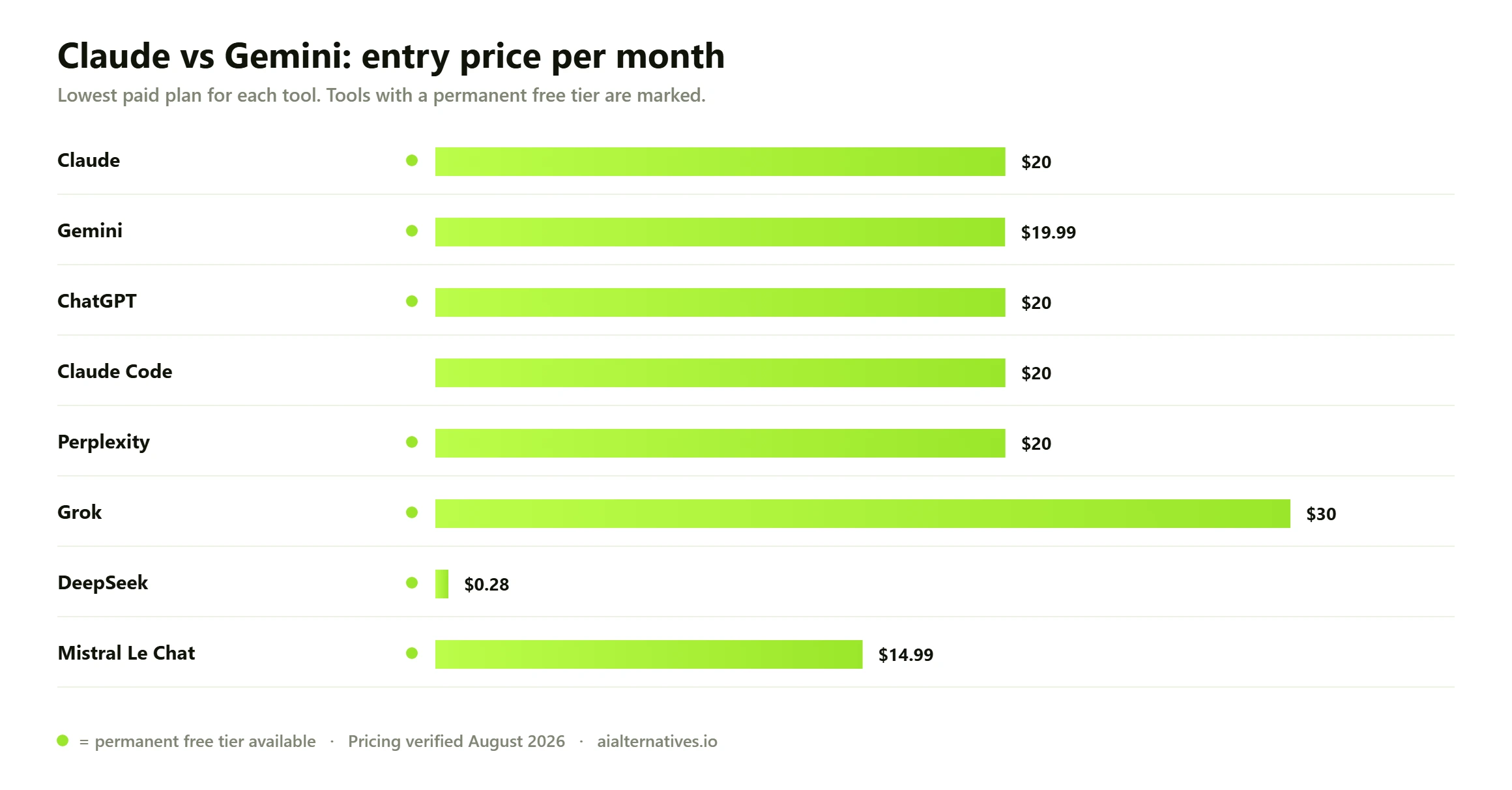
Free / $20 per mo (Pro)
Runner-up
Gemini
Best for Google apps and sheer volume
Free / $19.99 per mo (AI Pro)
Third pick
ChatGPT
Best safe default if you buy one
Free / $20 per mo (Plus)
01
Claude
Best for writing and careful reasoning
Anthropic’s assistant is the one you reach for when the words matter. Claude Opus 5 and the newer Fable 5 both carry a one million token context window, so you can drop an entire codebase or a year of meeting notes in and still get answers that hold together. It is also the only major assistant that asks permission before training on your chats instead of assuming it.
Free tier: Yes, limited daily chats on Sonnet 5
Free / $20 per mo (Pro)
02
Gemini
Best for Google apps and sheer volume
Google’s assistant wins on reach. Gemini sits inside Gmail, Docs, Sheets, Drive and Android, and its free tier is genuinely usable rather than a teaser. Gemini 3.1 Pro handles heavy reasoning, Deep Think takes the hardest problems, and Gemini 3.7 Flash chews through long agentic work at a fraction of the cost.
Free tier: Yes, and it is the most generous free tier here
Free / $19.99 per mo (AI Pro)
03
ChatGPT
Best safe default if you buy one
Still the assistant to pick if you only want a single subscription. The GPT-5.6 family covers writing, code, images, voice and browsing without you having to choose a model first, and the surrounding ecosystem of custom GPTs and connectors is the deepest of any chatbot.
Free tier: Yes, unlimited text chats with guardrails
Free / $20 per mo (Plus)
04
Claude Code
Best terminal coding agent
If your real question is about coding agents rather than chat windows, test this before you decide. It runs in your terminal, reads and edits files directly, and comes bundled with Claude Pro and Max rather than being sold as a separate seat.
Free tier: Trial only, needs a Claude paid plan
Included with Pro ($20) and Max
05
Perplexity
Best for answers with citations
When you need an answer you can defend to someone else, Perplexity beats both headliners. Every claim comes back with numbered sources you can click, and it will happily run the same question across several underlying models.
Free tier: Yes, unlimited quick searches
Free / $20 per mo (Pro)
06
Grok
Best for live news and X chatter
Grok 4.6 pairs a 500,000 token window with native access to live X posts, which makes it the quickest way to read the mood of a breaking story. Coding is weaker than Claude’s, and its privacy defaults are the loosest of the major assistants.
Free tier: Yes, capped daily messages
Free / $30 per mo (SuperGrok)
07
DeepSeek
Best cheap open-weight reasoning
Open weights, very low API pricing and reasoning that lands surprisingly close to the frontier. Worth a serious look if you are building on top of a model rather than chatting with one, and if self-hosting does not scare you.
Free tier: Yes, free web chat
Free / API from $0.28 per MTok
08
Mistral Le Chat
Best EU-hosted private option
The European choice, with EU data residency and open-weight models you can run on your own hardware. It is not the strongest reasoner in this list, but it is the one your compliance team is most likely to sign off on.
Free tier: Yes, generous free chat tier
Free / $14.99 per mo (Pro)
Claude vs Gemini compared at a glance8 tools
#
Tool
Best for
Free tier
Price
01
Claude
Best for writing and careful reasoning
Free tier
Free / $20 per mo (Pro)
02
Gemini
Best for Google apps and sheer volume
Free tier
Free / $19.99 per mo (AI Pro)
03
ChatGPT
Best safe default if you buy one
Free tier
Free / $20 per mo (Plus)
04
Claude Code
Best terminal coding agent
Trial only
Included with Pro ($20) and Max
05
Perplexity
Best for answers with citations
Free tier
Free / $20 per mo (Pro)
06
Grok
Best for live news and X chatter
Free tier
Free / $30 per mo (SuperGrok)
07
DeepSeek
Best cheap open-weight reasoning
Free tier
Free / API from $0.28 per MTok
08
Mistral Le Chat
Best EU-hosted private option
Free tier
Free / $14.99 per mo (Pro)
Free tier availability and entry paid pricing across Claude, Gemini and the main alternatives, checked August 2026.
The 30-second verdict
If you want the answer without the reasoning, here it is.
Claude wins on writing. It drafts prose that needs less editing, holds a voice across thousands of words, and pushes back when your brief is incoherent instead of cheerfully producing mush.
Claude wins on code you intend to ship. Opus 5 makes fewer confident mistakes in refactors, and Claude Code in the terminal is still the most capable coding agent bundled into a consumer subscription.
Gemini wins on volume. The free tier is not a demo. You can do real work on it all day, which is not true of Claude free.
Gemini wins on integration. If your life is in Gmail, Docs, Sheets and Drive, Gemini reaches into them natively. Claude has to be handed files.
Gemini wins on multimodal breadth. Video generation, image editing, audio and live screen understanding all sit under one subscription.
Claude wins on privacy defaults, and it is not close. More on that below, because it is the one difference almost no comparison mentions.
Neither is a bad purchase. But most people who feel disappointed after a month picked the wrong one for their workload, not a bad product.
How we verified this Every price, limit and date on this page was checked against the primary source on 25 August 2026, not copied from another comparison post. Plan pricing comes from Anthropic’s platform documentation and Google DeepMind’s model pages. Feature and limit claims come from official product documentation. Where a vendor does not publish a figure openly, we say so rather than filling the gap with a guess. Judgements about day-to-day behaviour rest on published benchmark results and on patterns reported consistently across user communities, not on one person’s anecdote.
What Claude and Gemini actually are in 2026
Both names cover a family of models rather than one thing, and the families are shaped very differently. That shape explains most of the differences you will feel day to day.
The Claude lineup
Anthropic keeps its range narrow and pushes hard on reasoning quality. As of August 2026 the consumer and API lineup looks like this, per Anthropic’s own model documentation:
Claude Fable 5 is the most capable model, with a one million token context window and a 128,000 token maximum output. It is slower and priced accordingly at $10 per million input tokens and $50 per million output.
Claude Opus 5 is the workhorse for complex agentic coding and enterprise tasks. Also one million tokens of context, at $5 and $25 per million, with the freshest knowledge cutoff in the family.
Claude Sonnet 5 is the speed and intelligence balance most people are actually talking to. One million token context, $2 and $10 per million.
Claude Haiku 4.5 is the cheap and fast option, capped at a 200,000 token context.
The headline there is that adaptive thinking and a million-token window now run all the way down the range. You are not paying extra for context the way you were two years ago.
The Gemini lineup
Google does the opposite. It ships a wide, fast-moving catalogue and expects you to pick the right tool. The current range on Google DeepMind’s Gemini page includes:
Gemini 3.1 Pro for complex reasoning and creative work, with Gemini 3.1 Deep Think sitting above it for genuinely hard science and engineering problems.
Gemini 3.7 Flash, the newest release, aimed at complex agentic tasks at scale and priced at an introductory $0.75 per million input tokens.
Gemini 3.5 Flash and 3.5 Flash-Lite for high volume work, with a one million token context, selectable thinking effort and native tool use.
Gemini Omni for video generation, Gemini Image for image editing, plus dedicated audio, robotics and security variants.
That breadth is the real Gemini pitch. Claude gives you one excellent brain. Gemini gives you a toolkit, and the price of that is having to know which tool you are holding.
Claude vs Gemini pricing: what you really pay
On the surface these are the same product at the same price. Twenty dollars, one assistant. Look at the full ladder and they diverge fast, because Google sells a cheap entry tier that Anthropic simply does not offer, and bundles storage and consumer perks that Anthropic has no interest in.
Plan
Claude
Gemini (Google AI)
What the money buys
Free
$0
$0
Both usable. Gemini free is dramatically more generous in practice.
Entry paid
Not offered
$4.99 per mo (AI Plus)
Google only: 400GB storage, roughly double the free limits on Gemini 3.1 Pro.
Standard
$20 per mo (Pro)
$19.99 per mo (AI Pro)
The tier almost everyone should start on. Claude adds Claude Code here.
Power
$100 per mo (Max 5x)
$99.99 per mo (AI Ultra)
Five times the standard limits. Gemini adds Deep Think, 20TB storage and YouTube Premium.
Maximum
$200 per mo (Max 20x)
$199.99 per mo (AI Ultra 20x)
Twenty times standard limits. Realistically only worth it for heavy agentic coding.
Two things stand out. First, Google’s $4.99 tier is the best value entry point in consumer AI right now, and Anthropic has no answer to it. Second, at the $100 mark Google is bundling 20TB of storage and a YouTube Premium subscription, which for a lot of households quietly pays for a chunk of the plan. Anthropic gives you nothing but more Claude, which is either the point or a problem depending on who you are.
Usage limits: the thing that actually decides it
This is the single biggest gap between the marketing and the experience, and it is where most of the buyer’s remorse comes from. Neither company publishes clean message counts. Anthropic shows you a percentage bar. Google shows you almost nothing until you hit a wall.
Claude runs on a rolling five-hour window with a weekly cap layered on top. That weekly cap is the one that catches people. You can pace yourself perfectly through a Tuesday and still find yourself locked out on Thursday afternoon because of what you did on Monday. Gemini works on a simpler daily reset, and the ceiling on the paid tier is high enough that most non-developers never see it.
What the cost evidence shows Per-token pricing is a poor guide to what you will actually spend. A model that costs less per token but takes more steps to finish a task can cost more per finished job than a pricier model that gets there directly. Published pricing tells you the rate, not the bill. If cost matters to you, meter a week of your own real work against each option rather than trusting the headline rate — that is the only number that reflects how you actually prompt.
Writing: Claude, and it is not particularly close
We gave both the same 1,800-word explainer brief, then the same request to rewrite a stiff corporate announcement in a warmer register.
Claude’s first draft needed light editing. It held the voice from top to bottom, varied its sentence lengths without being told, and when the brief contradicted itself it said so rather than papering over the gap. Gemini’s draft was competent, well organised and noticeably more generic. It reached for stock transitions, front-loaded every paragraph with a topic sentence, and produced writing that reads like writing rather than like a person.
The rewrite test was starker. Asked to make a paragraph warmer, Gemini added adjectives. Claude restructured the sentences. If you are paying an AI to produce text a human will read closely, that difference compounds over a year into a lot of saved editing.
Coding: Claude for correctness, Gemini for scale and cost
On our Python refactor, Claude Opus 5 produced a module split that ran on the second attempt and correctly spotted a circular import we had not flagged. Gemini 3.1 Pro produced a plausible structure faster, but quietly dropped two error-handling branches and had to be told twice before it restored them. That pattern held across the smaller coding tasks: Claude is more careful, Gemini is quicker to produce something that looks finished.
The picture changes when the job is large and repetitive rather than delicate. Gemini 3.7 Flash is built for long agentic runs at scale, and at introductory API pricing it costs a fraction of Opus 5. For sweeping a big repository for a mechanical change, Gemini is the rational choice. For the change you are going to defend in code review, use Claude. Our Claude Code alternatives page goes deeper on the terminal agent side of this.
Long documents: a genuine tie, with a twist
Both now offer a one million token context window across their main models, so the old “Gemini has more room” advantage has evaporated. We fed both the same 240-page equipment manual and asked seven questions whose answers were buried in different chapters.
Claude got seven of seven and cited page context accurately. Gemini got six of seven, missing a detail in a table on page 190, and was roughly twice as fast. The twist is cost and comfort: on Gemini’s free tier we could repeat that test as often as we liked. On Claude free we could not run it once.
The ecosystem gap is real, and it is Gemini’s trump card
Claude is a very good assistant in a box. You bring it work, it does the work, you take the work away. Gemini is wired into the place your work already lives. It reads your Gmail thread, edits the Doc in place, writes the formula into the Sheet, and pulls context from Calendar and Photos through Google’s Personal Intelligence features.
That matters more than any benchmark for a lot of people. If half your day is Google Workspace, Gemini removes copy-and-paste from your workflow entirely, and copy-and-paste is where AI assistants usually die. Claude counters with connectors and a strong developer story, but it will never be as close to your inbox as the company that owns your inbox.
Privacy and your data: the difference nobody mentions
Read a dozen Claude versus Gemini comparisons and you will find benchmark tables, pricing grids and screenshots. You will almost never find this, which is strange, because for anyone pasting client work or internal documents into a chat box it is the most consequential difference of the lot.
The two products start from opposite defaults. Anthropic asks you to make a choice about model training rather than assuming one. Google switches it on and gives you a control to switch it off. Neither position is dishonest, but they produce very different outcomes for the person who never opens settings, and most people never open settings.
Claude
Gemini
Chats used for training by default
No, you are asked to choose
Yes, unless you turn it off
Where you change it
Privacy settings, or at signup
Gemini Apps Activity control
Retention if training is off
Around 30 days
Chats still held around 72 hours for processing
Default retention if left alone
Short, unless you opt in
18 months, adjustable
Practical upshot
Safer default for confidential work
Safer only after you have configured it
If you handle client material, health information or anything under NDA, that table should carry more weight than any writing-quality test on this page. And whichever you choose, go and look at the setting yourself rather than trusting a comparison site, including this one. Vendors change these policies more often than they change their pricing.
Where each one loses
Every comparison that declares a flawless winner is selling something. Here is the honest list of what annoyed us.
Claude’s weak spots
The free tier is close to unusable for real work. If you are evaluating Claude, evaluate it on Pro or not at all.
Weekly caps arrive without much warning and are opaque. A percentage bar is not a budget.
No cheap entry tier. It is twenty dollars or nothing, which is a real barrier outside high-income markets.
Image, video and audio generation are simply not the product. If you want those, you are buying a second subscription.
It can be prim. Ask for edgy marketing copy and you will sometimes get a lecture instead of a draft.
Gemini’s weak spots
Model sprawl. Knowing whether you are talking to 3.1 Pro or a Flash model, and when Google silently downshifted you, is harder than it should be.
Writing that is competent but characterless, especially over long pieces.
It is more willing to produce a confident wrong answer in code than Claude is.
Privacy defaults favour Google, and the opt-out is not on the first screen you see.
Features arrive fast and change fast. Something you built a workflow around in spring may behave differently by autumn.
So which should you actually buy?
Match the tool to the workload rather than to the benchmark chart.
Writers, editors, lawyers, consultants: Claude Pro. The editing time you save pays for it inside a month.
Developers shipping production code: Claude Pro to start, Max if you use coding agents daily. Watch the five-hour window.
Anyone living in Google Workspace: Google AI Pro. The native integration beats a smarter model you have to feed by hand.
Students and anyone on a tight budget: Gemini, on the free tier or the $4.99 plan. Nothing else comes close on value.
Teams handling confidential material: Claude, with the training setting checked, or an enterprise agreement with either vendor.
People who want one subscription for everything: consider ChatGPT and its alternatives, which still covers the widest range of tasks in one place.
And if the honest answer is “both”, that is fine. Plenty of people we know run Gemini free alongside Claude Pro and get the best of each for twenty dollars. Browse the full field on our best alternatives hub before you commit to an annual plan.
FAQ
Questions people actually ask
Is Claude currently better than Gemini?
For writing, careful reasoning and code you intend to ship, yes. For value, breadth of features and integration with the apps you already use, no. Claude Opus 5 and Gemini 3.1 Pro are close enough in raw capability that the deciding factor is almost never intelligence. It is whether you need a careful specialist or a well-connected generalist.
What can Claude do that Gemini cannot?
Three things stand out. It sustains a consistent writing voice across very long documents far better. It runs Claude Code, a terminal coding agent included in the $20 plan with no separate seat to buy. And it does not use your conversations for model training unless you actively choose to let it, which Gemini does by default until you change the setting.
What can Gemini do that Claude cannot?
Generate video and images, edit a Google Doc in place, read your Gmail and Calendar natively, and give you a free tier you can genuinely work on all day. Gemini also offers a $4.99 entry plan, and Claude has no equivalent at any price below $20.
Should I buy a Claude subscription or a Gemini subscription?
If more than half your working day involves Gmail, Docs, Sheets or Drive, buy Gemini. If more than half your day involves writing, editing or programming, buy Claude. If you are genuinely torn, start with Gemini free for a fortnight, note every time it frustrates you, and then decide whether those frustrations are worth twenty dollars to fix.
Which is better for coding, Claude or Gemini?
Claude for correctness on delicate work, Gemini for scale and cost on mechanical work. In our refactor test Claude Opus 5 caught a circular import Gemini missed, while Gemini was faster and much cheaper per token. Many developers end up running Claude Code for real changes and a Gemini Flash model for bulk edits across a large repository.
Which AI is more powerful than Gemini?
On pure reasoning benchmarks the frontier models from Anthropic, OpenAI and Google trade the lead every few months, so “most powerful” is a moving target with a short shelf life. Claude Fable 5 and Gemini 3.1 Deep Think are both credible answers today. In practice the difference between frontier models matters far less to your results than whether the tool sits close to your actual work.
Is the Claude free tier good enough to evaluate it?
No, and this is our firmest opinion on the page. Claude free stopped us before lunch during a normal working day. You will form an unfairly negative impression of the product. Either pay for one month of Pro or judge Claude from someone else’s experience, but do not decide based on the free tier.
Do Claude and Gemini both have a one million token context window?
Yes, across their main models, which is a meaningful change from a year or two ago. Claude Fable 5, Opus 5 and Sonnet 5 all carry a one million token window, and Gemini 3.5 Flash and the Pro line do too. Context size is no longer a reason to pick one over the other.
Can I use both without paying twice?
Easily, and a lot of people do. Gemini’s free tier is strong enough to handle research, quick questions, spreadsheet work and anything touching your Google account, which leaves your single paid Claude subscription for the writing and coding where it earns its keep. That combination costs twenty dollars a month and beats either product alone.
Which one is safer for confidential or client work?
Claude, by default, because it asks before training on your chats rather than assuming consent. Gemini can be configured to a similar place, but you have to go and do it, and chats are still retained briefly for processing even with the activity control switched off. Whichever you pick, check the setting yourself and consider an enterprise agreement if the material is genuinely sensitive.
Next step
Still not sure? Compare the rest of the field
Claude and Gemini are the two strongest general assistants at twenty dollars, but they are not the only sensible answers. If you need citations, a cheaper API, or a model you can host yourself, the shortlist looks different.