01
pCloud
One-time lifetime storage
Buy 2TB once for $399 and you’ll never pay again. If you want zero-knowledge encryption, it’s real, but you’ll need the pCloud Encryption add-on at $49.99 a year.
Free tier: Up to 10GB free, no card needed
New this week: 6 head-to-head tests added, including Claude vs Gemini for long documents.
See what changed →If you’re still on Dropbox’s free plan, you’re getting 2GB, the same 2GB you’d have gotten back in 2008. Since 2019, you’ve also been capped at three linked devices. Meanwhile the company cut 20% of its staff, killed off Passwords and Send and Track, and shifted its attention to an AI search product. If you’re hunting for Dropbox alternatives, that drift is probably why you’re here.
Here you’ll find nine alternatives to Dropbox, compared on the three things that actually decide your switch: what you’ll pay per terabyte, how much you get free, and whether the provider can read your files. Every price was checked against official pricing pages in August 2026.
Some of these will cost you half what Dropbox does. Two of them can’t decrypt your data even if subpoenaed. One costs you nothing forever, if you’re willing to run your own server.
Ranked by testing, current pricing and free-tier value. Details on every pick below the list.
One-time lifetime storage
Free / $99.99 per yr (2TB) / $399 lifetimeZero-knowledge teams and solos
Free / from $8 per mo (1TB)Free storage and collaboration
Free / $1.99 per mo (100GB) / $99.99 per yr (2TB)One-time lifetime storage
Buy 2TB once for $399 and you’ll never pay again. If you want zero-knowledge encryption, it’s real, but you’ll need the pCloud Encryption add-on at $49.99 a year.
Free tier: Up to 10GB free, no card needed
Zero-knowledge teams and solos
Every file you store is end-to-end encrypted by default, including your shared links. The trade-off: slower uploads and no third-party app ecosystem.
Free tier: 5GB free, encrypted like every paid plan
Free storage and collaboration
You get seven times Dropbox’s free storage and the best real-time document editing around. Just know Google holds the keys, so treat it as convenient, not private.
Free tier: 15GB shared with Gmail and Photos
Privacy-first personal files
You get Swiss-based, open-source clients with encrypted metadata and file names. It’ll cost you roughly $239 per TB per year, so use it for documents, not your media library.
Free tier: 5GB free with full end-to-end encryption
Windows and Office users
It’s already baked into your Windows File Explorer and Office. Microsoft 365 Family gives you and five others 1TB each for $129.99 a year, the best per-person deal here.
Free tier: 5GB free
Cheap paid terabytes
You’ll pay about $40 per TB per year on the 5TB plan, well under Dropbox. Just know client-side encryption only covers your dedicated encrypted folder.
Free tier: 10GB free, no encrypted folder
The largest free tier
You get end-to-end encryption by default, and it’s the cheapest bulk storage on this list at roughly $23 per TB per year on the 10TB plan. Watch for transfer quotas though.
Free tier: 20GB free, 10x Dropbox Basic
Regulated business teams
You get unlimited storage from the Business tier up, with granular retention, legal hold and admin controls. If you’re just one person, it’s overkill and overpriced.
Free tier: 10GB free for individuals
Self-hosting and full control
You run an open-source sync, calendar, contacts and office suite on your own hardware. That makes you the sysadmin, backups and updates included.
Free tier: Unlimited, bounded only by your disk
| # | Tool | Best for | Free tier | Price |
|---|---|---|---|---|
| 01 | pCloud | One-time lifetime storage | Free tier | Free / $99.99 per yr (2TB) / $399 lifetime |
| 02 | Sync.com | Zero-knowledge teams and solos | Free tier | Free / from $8 per mo (1TB) |
| 03 | Google Drive | Free storage and collaboration | Free tier | Free / $1.99 per mo (100GB) / $99.99 per yr (2TB) |
| 04 | Proton Drive | Privacy-first personal files | Free tier | Free / $3.99 per mo (200GB) |
| 05 | Microsoft OneDrive | Windows and Office users | Free tier | Free / $1.99 per mo (100GB) / $99.99 per yr (1TB) |
| 06 | Icedrive | Cheap paid terabytes | Free tier | Free / $59 per yr (1TB) / $199 per yr (5TB) |
| 07 | MEGA | The largest free tier | Free tier | Free / $9.78 per mo (3TB, billed yearly) |
| 08 | Box | Regulated business teams | Free tier | Free / $15 per user per mo (Business) |
| 09 | Nextcloud | Self-hosting and full control | Free tier | Software free / VPS hosting from about $5 per mo |
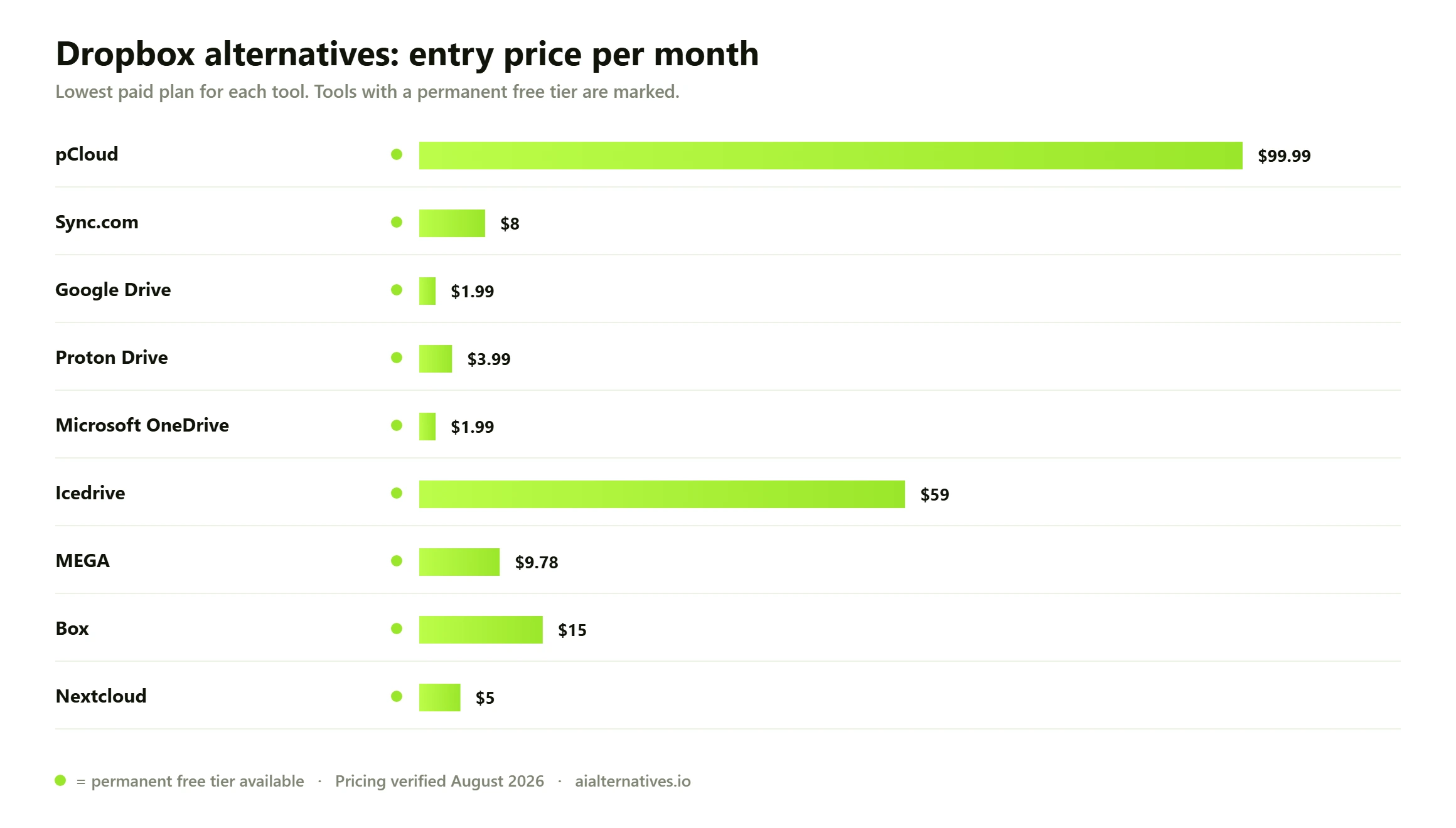
Dropbox isn’t dying on you. It’s drifting. And you can measure the drift.
In its fourth quarter and fiscal 2025 results, released 19 February 2026, Dropbox reported $2.52 billion in revenue, down 1.1% year over year. Paying users fell from 18.22 million to 18.08 million. Average revenue per user slipped too.
The cuts came first. On 30 October 2024, Drew Houston told staff the company was eliminating about 20% of roles, roughly 528 people. He wrote that the file sync and share business “has matured” and cited softening demand. Engineering attention shifted to Dropbox Dash, an AI search layer that indexes other apps.
If you used Dropbox Passwords, it went read-only on 28 August 2025, lost mobile access on 11 September, and had its stored vaults deleted on 28 October 2025. Send and Track was retired earlier that same year. Capture and Vault went too. That’s a lot of churn for a service you probably chose because it was boring and reliable.
Dropbox Basic still gives you 2GB. Google gives you 15GB, MEGA gives you 20GB, pCloud and Icedrive give you 10GB. Worse, your free account has been capped at three linked devices since 2019. Phone, laptop, tablet: you’re done.
Dropbox Plus will run you $9.99 a month for 2TB billed yearly, or $11.99 month to month. That works out to about $60 per TB per year. Google One charges you $99.99 a year for the same 2TB. pCloud matches Google. MEGA and Icedrive undercut both.
All prices verified on official pricing pages in August 2026. Where a service was running a promotion, the regular rate is what we quote.
| Tool | Best for | Starting price | Free plan |
|---|---|---|---|
| pCloud | One-time lifetime storage | $49.99/yr (500GB) | Up to 10GB |
| Sync.com | Zero-knowledge teams and solos | From $8/mo (1TB) | 5GB |
| Google Drive | Free storage and collaboration | $1.99/mo (100GB) | 15GB |
| Proton Drive | Privacy-first personal files | $3.99/mo (200GB) | 5GB |
| Microsoft OneDrive | Windows and Office users | $1.99/mo (100GB) | 5GB |
| Icedrive | Cheap paid terabytes | $59/yr (1TB) | 10GB |
| MEGA | The largest free tier | $9.78/mo (3TB, yearly) | 20GB |
| Box | Regulated business teams | $15/user/mo | 10GB |
| Nextcloud | Self-hosting and full control | Free software, ~$5/mo hosting | Unlimited (your disk) |
pCloud is the only mainstream option that sells you storage outright. 500GB costs $199 one time, 2TB is $399, 10TB is $1,190. Spread the 2TB plan over a decade and you’re paying under $20 per TB per year, roughly a third of what Dropbox charges.
What you won’t get: zero-knowledge encryption by default. You’ll need the pCloud Encryption add-on at $49.99 a year or $150 lifetime, and it only protects one designated folder. Pick pCloud if you hate subscriptions and mostly store media.
Sync encrypts client-side on every plan, free included, and that extends to your shared links. The company is Canadian, holds SOC 2, HIPAA and GDPR coverage, and can’t reset your password because it never sees your key. Personal 1TB runs from $8 a month billed yearly.
What you won’t get: live document co-editing, a plugin ecosystem, or Google’s upload speed. Pick Sync if your files are contracts, client work or medical records.
15GB free is seven Dropbox Basics. Paid, 100GB is $1.99 a month and 2TB is $99.99 a year, cheaper than Dropbox Plus for the same space. Docs, Sheets and Slides remain the best collaborative editors you’ll find.
What you won’t get: privacy. Google holds the keys, and your 15GB is shared with Gmail and Photos, so it fills faster than it looks. There’s also no tier between 200GB and 2TB. Pick Drive if you collaborate more than you archive.
Proton encrypts file contents, file names and folder structure end-to-end using OpenPGP and Curve25519. It’s Swiss, open source on the client side, and independently audited. Drive Plus gives you 200GB at $3.99 a month billed yearly; Proton Unlimited bundles 500GB with VPN, Mail and Pass at $9.99 a month.
What you won’t get: capacity per dollar. At roughly $239 per TB per year, it’s the most expensive option here. Pick Proton for sensitive documents, not a 4TB photo archive.
If you run Windows, OneDrive is already sitting in your File Explorer. Microsoft 365 Personal is $99.99 a year with 1TB; Family is $129.99 a year and gives you and five others 1TB each. That’s the cheapest per-person terabyte in this comparison by a wide margin.
What you won’t get: standalone storage. Microsoft has been folding OneDrive into Microsoft 365 bundles, and OneDrive for Business Plan 1 stops accepting new signups on 31 May 2026. No zero-knowledge option. Pick OneDrive if your household already needs Office.
Icedrive’s 5TB plan runs $199 a year, about $40 per TB. 1TB is $59 a year. The desktop client mounts storage as a virtual drive, which feels closer to old-school Dropbox than most rivals manage.
What you won’t get: broad or mature encryption. Client-side Twofish encryption only applies inside your dedicated encrypted folder, and only on paid plans. Support is thin. Pick Icedrive if price per terabyte is what decides it for you.
20GB free is the largest no-strings free tier on this list, and everything is end-to-end encrypted by default. Pro II gives you 10TB for $234.72 a year, about $23 per TB. Note the monthly transfer quotas, and that MEGA uses AES-128 rather than AES-256.
Box is where you go when you’re a Dropbox Business customer and compliance matters. Storage is unlimited from the $15 per user Business tier up, with retention policies, legal hold and detailed audit logs. As an individual you get 10GB free, but a 100GB Personal Pro plan at $10 a month is poor value.
Nextcloud is free open-source software you install on a VPS or a box in your closet. Sync, calendars, contacts, a document editor, and WebDAV support. A $5-a-month VPS covers a small household. You inherit backups, updates and uptime, which is the entire cost.
If you only want free Dropbox alternatives, the ranking is simple and Dropbox loses badly. MEGA leads with 20GB, all of it end-to-end encrypted. Google Drive gives you 15GB but shares it with Gmail and Google Photos. pCloud, Icedrive and Box each give you 10GB. Sync.com, Proton Drive and OneDrive give you 5GB.
Dropbox Basic gives you 2GB and links only three devices. That device cap is the part you’ll notice first, and it’s the reason most people search for dropbox alternatives free of arbitrary limits.
Headline prices hide the real comparison. Here is the annual cost divided by storage, using each provider’s best-value tier.
| Plan | Storage | Annual cost | Cost per TB / year |
|---|---|---|---|
| Dropbox Plus | 2TB | $119.88 | ~$60 |
| MEGA Pro II | 10TB | $234.72 | ~$23 |
| Icedrive Pro V | 5TB | $199 | ~$40 |
| pCloud Premium Plus | 2TB | $99.99 | ~$50 |
| pCloud 2TB lifetime | 2TB | $399 once | ~$20 over 10 years |
| Google One | 2TB | $99.99 | ~$50 |
| Microsoft 365 Personal | 1TB | $99.99 | ~$100 |
| Proton Drive Plus | 200GB | $47.88 | ~$239 |
Read it this way: privacy costs money. MEGA and Icedrive are cheap because they compete on volume. Proton is expensive because encrypted, audited, Swiss-hosted storage is expensive to run. Dropbox sits in the middle and offers neither advantage.
“Encrypted” is marketing. Zero-knowledge means the provider can’t decrypt your files because it never holds the key. That distinction gets blurred constantly, so here it is straight, for you.
Zero-knowledge by default, on every file: Sync.com, Proton Drive, Tresorit, Internxt and MEGA. Lose your password on any of these and your data is gone. That is the point.
Zero-knowledge only in a special folder: pCloud, via the paid pCloud Encryption add-on, and Icedrive, via its encrypted folder on paid plans. Everything outside that folder is encrypted at rest with keys the provider holds.
Not zero-knowledge at all: Google Drive, Microsoft OneDrive, Box and Dropbox itself. Files are encrypted in transit and at rest, but the provider can decrypt them for search, previews, malware scanning and legal requests.
Depends entirely on you: Nextcloud. Self-hosted means you hold everything, including responsibility for getting it right.
Dropbox Business gives you 9TB pooled at $18 per user per month billed annually, with a three-user minimum. Business Plus is 15TB at $26 per user. End-to-end encryption isn’t standard on those tiers.
If you’re shopping Dropbox alternatives for your business, three routes make sense. Box at $15 per user per month gives you unlimited storage plus retention, legal hold and audit trails, which is what you need if you’re in a regulated industry. Sync.com Teams starts around $6 per user per month and is the only mainstream team plan where the vendor can’t read your files, with HIPAA and GDPR coverage included. Microsoft 365 Business Basic at $6 per user per month bundles 1TB each with Teams, Exchange and the Office web apps, which is hard to beat on total cost.
If you’re a small design or media team drowning in raw files, pCloud Business at $7.99 per user per month includes the encryption add-on individuals pay extra for.
Match the tool to your files, not to the brand.
One practical note: check what happens to your shared links. Sync.com and Proton links stay encrypted; Google and Microsoft links are indexable and easier for your collaborators to open. That difference decides more migrations than storage size does.
Usually yes, on price alone. Move 2TB from Dropbox Plus to Google One or pCloud and you’ll save about $20 a year for identical space. Move to Icedrive’s 5TB plan and you get two and a half times the storage for $80 a year more. Move to pCloud lifetime and you stop the bleeding entirely.
The privacy case is stronger still. Dropbox is the only tool on this list that offers you neither a price advantage nor an encryption advantage.
Stay if your workflow depends on Dropbox integrations. Dropbox still has the deepest third-party app support of any consumer sync tool, and its selective sync and LAN sync remain genuinely excellent. Stay if you run Dropbox Business with shared team folders that dozens of external collaborators already link to; the migration cost is real and the disruption is not free.
And be honest with yourself about the free tiers. If 2GB has never bothered you, a 15GB or 20GB free plan won’t change your life. The switch pays off when you’re already paying, or already annoyed.
The questions people actually ask on Google, Reddit and Quora — answered with what we verified this month.
How we testMEGA, with 20GB free and end-to-end encryption on everything. Google Drive is second at 15GB, but that space is shared with Gmail and Google Photos, so it fills up faster than the number suggests. pCloud, Icedrive and Box each offer you 10GB free. All five beat Dropbox Basic’s 2GB and its three-device cap.
It pays off for you if you keep the account longer than about three and a half years. pCloud’s 2TB lifetime plan is $399 one time versus $119.88 a year for Dropbox Plus at the same capacity. The obvious risk is company longevity, though pCloud has sold lifetime plans since 2015 and is Swiss-registered. Zero-knowledge encryption still costs you extra, at $150 lifetime.
Sync.com, Proton Drive, Tresorit, Internxt and MEGA encrypt every file client-side by default, so the provider can’t read your data. pCloud and Icedrive only do this inside a dedicated encrypted folder, and pCloud charges you $49.99 a year for the feature. Google Drive, OneDrive, Box and Dropbox aren’t zero-knowledge at all.
No. Dropbox reported $2.52 billion in revenue for fiscal 2025 and is profitable. But revenue fell 1.1% year over year, paying users dropped from 18.22 million to 18.08 million, and the company cut roughly 20% of staff in October 2024. It has also retired Passwords, Send and Track, Vault and Capture while pushing its AI search product, Dash.
Google One and pCloud both charge you $99.99 a year for 2TB, undercutting Dropbox Plus at $119.88. If you can pay up front, pCloud’s 2TB lifetime plan at $399 works out cheaper than any subscription after about four years. Need more than 2TB? MEGA’s 10TB plan at $234.72 a year is your best value, at roughly $23 per TB.
Yes, every existing dropbox.com share link breaks once you delete the source files. Plan for it: export with the desktop client rather than the web downloader to preserve your folder structure, keep the Dropbox account alive for a month while you reshare, and send collaborators the new links before you cancel.
See how the top picks square off head to head, or browse every alternative guide we publish.