The 9 Best Mailchimp Alternatives in 2026, Ranked by Real Cost
If you use Mailchimp, here’s the thing: your bill grows faster than your list does. That’s the whole problem. On 17 February 2026 the free plan shrank to 250 contacts and 500 sends a month. Automation left the free tier entirely.
Worse, Mailchimp still counts unsubscribed and non-subscribed people toward your paid tier. You’re paying for contacts who already walked away. At 25,000 contacts that’s roughly $310 a month for email you could send for under $70.
We checked 9 Mailchimp alternatives against the same two list sizes you’re probably weighing: 5,000 and 25,000 contacts. Every price below was verified on official pricing pages in August 2026. Free plans included, with the real send limits.
Ranked by testing, current pricing and free-tier value. Details on every pick below the list.
Best overall
MailerLite
Best all-round Mailchimp replacement
Free / from $12 per mo
Runner-up
Brevo
Big lists, infrequent sends
Free / from $9 per mo
Third pick
Kit
Creators and paid newsletters
Free / from $33 per mo
01
MailerLite
Best all-round Mailchimp replacement
The closest like-for-like swap, at roughly half the price. Unsubscribed and bounced contacts don’t count toward your tier, and nonprofits get 30% off.
Free tier: 250 subscribers, 2,500 emails per month
Free / from $12 per mo
02
Brevo
Big lists, infrequent sends
Brevo (formerly Sendinblue) bills by emails sent, not contacts stored. If you have 25,000 subscribers and mail twice a month, this is the single biggest saving on the list.
Free tier: Unlimited contacts, 300 emails per day
Free / from $9 per mo
03
Kit
Creators and paid newsletters
Kit (formerly ConvertKit) gives you the most generous free tier in email, full stop. The catch is one basic automation and Kit branding on your forms.
Free tier: Up to 10,000 subscribers, unlimited sends
Free / from $33 per mo
04
beehiiv
Newsletters with ad revenue
Built for publishing, not campaigns. You get it free up to 2,500 subscribers with unlimited sends, then paid tiers unlock paid subscriptions and the ad network.
Free tier: 2,500 subscribers, unlimited sends
Free / from $43 per mo
05
Omnisend
Shopify and ecommerce stores
You get pre-built cart abandonment and browse abandonment flows that actually convert out of the box. Cheaper than Klaviyo at every tier we checked.
Free tier: 250 contacts, 500 emails per month
Free / from $11 per mo
06
Zoho Campaigns
Cheapest paid plans overall
The best free-to-paid value if you already touch the Zoho ecosystem. The interface feels dated and the automation builder is basic.
Free tier: 2,000 contacts, 6,000 emails per month, no automation
Free / about $27 per mo at 5k
07
Loops
SaaS product and lifecycle email
Flat, predictable pricing with unlimited sends and no per-seat charges. If you run a product team, marketing and transactional email living in one place will suit you.
Free tier: 1,000 contacts, 4,000 sends per month
Free / $49 per mo
08
Klaviyo
Data-heavy ecommerce brands
You get the strongest segmentation and revenue reporting in ecommerce. It’s also the most expensive option here at scale, and it bills you on active profiles.
Free tier: 250 profiles, 500 email sends per month
Free / from $20 per mo
09
Constant Contact
Nonprofits and event marketing
Phone support and event registration tools Mailchimp doesn’t match. If you’re a nonprofit, you get up to 30% off when prepaying annually.
Free tier: None. 60-day trial, no card required
No free plan / from $12 per mo
Mailchimp alternatives compared at a glance9 tools
#
Tool
Best for
Free tier
Price
01
MailerLite
Best all-round Mailchimp replacement
Free tier
Free / from $12 per mo
02
Brevo
Big lists, infrequent sends
Free tier
Free / from $9 per mo
03
Kit
Creators and paid newsletters
Free tier
Free / from $33 per mo
04
beehiiv
Newsletters with ad revenue
Free tier
Free / from $43 per mo
05
Omnisend
Shopify and ecommerce stores
Free tier
Free / from $11 per mo
06
Zoho Campaigns
Cheapest paid plans overall
Free tier
Free / about $27 per mo at 5k
07
Loops
SaaS product and lifecycle email
Free tier
Free / $49 per mo
08
Klaviyo
Data-heavy ecommerce brands
Free tier
Free / from $20 per mo
09
Constant Contact
Nonprofits and event marketing
Free tier
No free plan / from $12 per mo
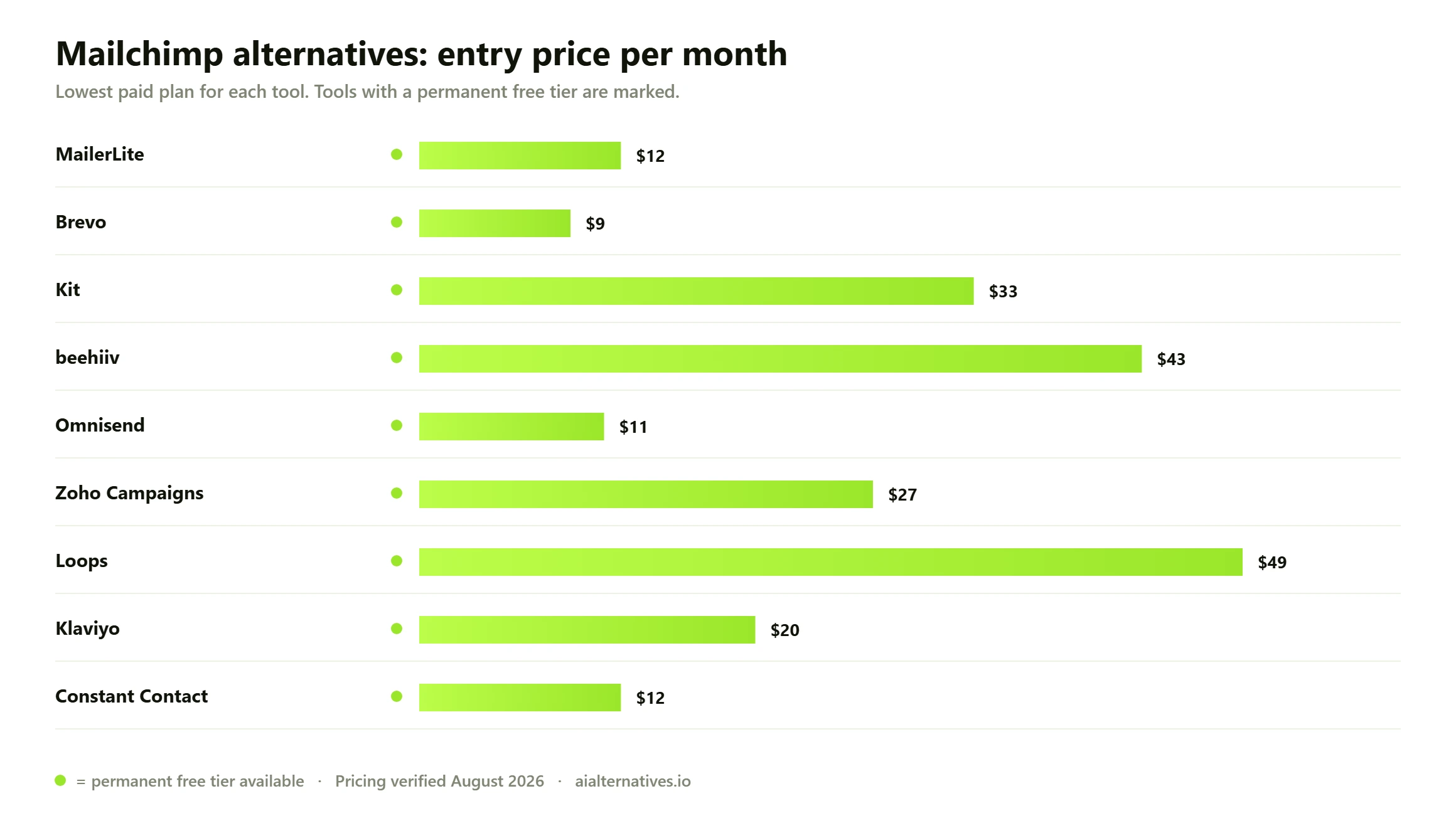
Entry monthly price across every Mailchimp alternative we tested. Green dot marks a permanent free tier. Pricing verified August 2026.
Why people are leaving Mailchimp
It isn’t the features that are driving you away. It’s the invoice.
The free plan keeps shrinking
On 17 February 2026 Mailchimp cut the free plan to 250 contacts and 500 sends per month. It was 500 contacts and 1,000 sends before that. In 2022 it was 2,000 contacts. If you were counting on automation, that got removed from free at the same time.
Legacy accounts got repriced
If your account was opened before May 2019, it was moved onto current pricing from the first billing cycle after 13 April 2026. The average increase landed around 11-13%. Some plans have risen 20-30% since 2022.
You pay for people who unsubscribed
This is the one that stings. Subscribed, unsubscribed and non-subscribed contacts all count toward your billable tier. Only archived or deleted contacts fall off. Duplicate emails across two audiences are billed twice. Check the tier slider on Mailchimp’s pricing page and the jumps are steep.
Intuit is running it for profit, not growth
On 20 May 2026 Intuit announced it was reducing its full-time workforce by 17%, with $300-340 million in restructuring charges. In the same release, Intuit reported Global Business Solutions growth twice: 15% including Mailchimp, 17% excluding it. Reporting a product separately in the negative direction tells you where investment is going.
Mailchimp alternatives compared at a glance
Starting prices are the lowest paid tier, billed monthly, verified August 2026.
Tool
Best for
Starting price
Free plan
MailerLite
All-round Mailchimp replacement
From $12 per mo
250 subs, 2,500 emails per mo
Brevo
Big lists, infrequent sends
From $9 per mo
Unlimited contacts, 300 emails per day
Kit
Creators and paid newsletters
From $33 per mo
10,000 subs, unlimited sends
beehiiv
Newsletters with ad revenue
From $43 per mo
2,500 subs, unlimited sends
Omnisend
Shopify and ecommerce
From $11 per mo
250 contacts, 500 emails per mo
Zoho Campaigns
Cheapest paid plans
About $27 per mo at 5k
2,000 contacts, 6,000 emails per mo
Loops
SaaS lifecycle email
$49 per mo
1,000 contacts, 4,000 sends per mo
Klaviyo
Data-heavy ecommerce
From $20 per mo
250 profiles, 500 sends per mo
Constant Contact
Nonprofits and events
From $12 per mo
None (60-day trial)
What you’d actually pay at 5,000 and 25,000 contacts
Starting prices are marketing. This is the number that matters. All figures are monthly billing, US pricing, checked August 2026.
Tool and plan
5,000 contacts
25,000 contacts
Billed on
Mailchimp Standard
~$100
~$310-340
Contacts, incl. unsubscribed
Mailchimp Essentials
~$75
~$270-300
Contacts, incl. unsubscribed
Brevo Starter
$29 (20k emails)
$69 (100k emails)
Emails sent
Zoho Campaigns Standard
~$27
~$76-150
Contacts
Loops
$49
Custom
Subscribed contacts
MailerLite Comfort
$49
~$180
Active subscribers only
Omnisend Standard
$81
$282
Contacts
beehiiv Scale
$89
$169
Subscribers
Kit Creator
$89
$199
Subscribers
Constant Contact Lite
$80
$280
Contacts
Klaviyo Email
$100
$400
Active profiles
Read the Brevo row again. A 25,000-contact list mailed four times a month is 100,000 emails. That’s $69 on Brevo versus roughly $310 on Mailchimp Standard. Same list, same sends, about $2,900 a year in difference.
Storage-based billing punishes you for having a list. Send-based billing punishes you for using it. Pick the model that matches how often you actually mail.
The top Mailchimp alternatives, reviewed
1. MailerLite – the straight swap
MailerLite does what most Mailchimp users need, for roughly half the money. The editor is cleaner, landing pages are included, and the automation builder is genuinely usable on entry plans. Unsubscribed and bounced contacts don’t count toward your tier.
What it lacks: deep ecommerce revenue attribution and Mailchimp’s template library breadth. Approval for new accounts can take a day or two. Comfort is $12 at 500 subscribers and $49 at 5,000. Pick it if you’re a small business or blogger who just wants the same job done cheaper.
2. Brevo – the cost killer for big lists
Brevo charges for emails sent, not contacts stored. You can store 100,000 people for free. The free plan is 300 emails a day forever, with no contact cap. Starter is $29 for 20,000 emails a month, $69 for 100,000.
What it lacks: deliverability is good but not best-in-class, and Starter requires a $10 add-on to remove Brevo branding. Pick it if you have a large, lightly-mailed list, or if a big chunk of your list is dormant.
3. Kit – the best free tier in email
Kit gives you up to 10,000 subscribers free with unlimited sends. Nothing else on this list comes close. Tag-based subscriber management beats Mailchimp’s audience model if you segment by interest.
What it lacks: one basic automation on free, Kit branding on forms, and plain-text-leaning templates that won’t suit a retail brand. Creator runs $89 at 5,000 and $199 at 25,000. Pick it if you’re a creator, writer or coach.
4. beehiiv – built for newsletters that earn
beehiiv’s Launch plan is free to 2,500 subscribers with unlimited sends. Paid tiers add paid subscriptions, an ad network and a referral program you can turn on. Scale is $89 at 5,000 and $169 at 25,000, which is the cheapest of the creator tools at scale.
What it lacks: it isn’t a general marketing platform. No real ecommerce flows, thin CRM. Pick it if your newsletter is the product.
5. Omnisend – Klaviyo features without Klaviyo prices
Omnisend ships cart abandonment, browse abandonment and post-purchase flows ready to switch on. Shopify and WooCommerce integrations are one-click. Standard is $81 at 5,000 contacts and $282 at 25,000, with email credits at 12x your contact count.
What it lacks: reporting depth versus Klaviyo, and SMS was pulled from Standard for new subscribers after 4 May 2026. Pick it if you run a store under roughly $1M and want flows working this week.
6. Zoho Campaigns – the cheapest way to leave
The free plan gives you 2,000 contacts and 6,000 emails a month. That’s eight times Mailchimp’s free contact cap. Paid plans start around $27 a month at 5,000 contacts.
What it lacks: automation is missing from free entirely, the UI feels a decade old, and support is slow. Pick it if budget is the only variable and you can live with rough edges.
Free Mailchimp alternatives: what the free plans really give you
Mailchimp’s free plan is now 250 contacts and 500 sends a month, with no automation. Most free Mailchimp alternatives beat that easily, whatever you’re comparing. Here’s the honest ranking by usable capacity.
Kit – 10,000 subscribers, unlimited sends. One automation, Kit branding on forms.
Brevo – unlimited contacts, 300 emails a day (about 9,000 a month). Brevo branding stays.
Zoho Campaigns – 2,000 contacts, 6,000 emails a month. No automation workflows.
beehiiv – 2,500 subscribers, unlimited sends, up to 3 publications. No monetization tools.
Loops – 1,000 contacts, 4,000 sends a month, every feature unlocked. Loops footer on emails.
Resend – 3,000 emails a month, 100 a day. Developer-first, API only.
MailerLite, Omnisend, Klaviyo – all now cap free at 250 contacts, same as Mailchimp.
One warning. Free tiers are the first thing vendors cut. MailerLite halved its free plan in 2026, Mailchimp has cut its three times since 2022. If your list is a business asset, budget for a paid plan rather than betting on someone else’s free tier surviving.
Mailchimp alternatives for nonprofits
Mailchimp gives verified nonprofits 15% off Essentials, Standard and Premium. You have to request it before you buy a paid plan, and US organizations need a 501(c)(3) determination letter. Add-ons and transactional email are excluded, and it doesn’t stack with other offers.
Two alternatives beat that outright, if you qualify. MailerLite gives approved nonprofits 30% off all paid plans. Constant Contact offers 20% off when you prepay six months, or 30% off prepaying twelve.
The discount is the smaller story though. A donor list is full of lapsed and unsubscribed records. Mailchimp bills you for those. MailerLite doesn’t. For a 25,000-record donor database, that difference outweighs any percentage off.
How to choose
Match the billing model to your sending pattern first. Everything else is secondary.
Large list, occasional sends? Brevo. Send-based billing turns your dormant list from a liability into a free asset.
Small business doing normal campaigns? MailerLite. It’s the fewest compromises for your money.
Creator or newsletter? Kit if you’re under 10,000 and want free. beehiiv if you want ads and paid subscriptions.
Ecommerce? Omnisend under about $1M revenue, Klaviyo above it. Klaviyo’s segmentation earns its price only when you have the data volume to feed it.
SaaS or product email? Loops for flat pricing with a marketing UI, Resend if your team would rather write code than click a builder.
Nonprofit or event-driven? Constant Contact for the discount and phone support, MailerLite if you’d rather just pay less.
Is switching worth it?
Below about 1,000 contacts, probably not. The saving is $10-20 a month and migration costs you a weekend. Stay put and revisit at 5,000.
Above 5,000 contacts, yes. The gap widens fast. At 25,000 contacts you’re looking at $1,500 to $2,900 a year, every year, for a job several tools do as well or better.
Stay on Mailchimp if you’ve built complex multi-step automations you’d have to rebuild, if you’re tied into Intuit’s QuickBooks or Square integrations, or if your team genuinely uses the content studio and template library. Those are real switching costs.
Leave if your list is growing, if a large share of it is unsubscribed or inactive, or if you’re on a legacy plan that just got repriced. Export your list as CSV, import it, warm up sending over two weeks, then run both in parallel for one campaign before you cancel. Keep your old account until DNS and authentication records are confirmed working on the new one.
Questions
Mailchimp alternatives FAQs
The questions people actually ask on Google, Reddit and Quora — answered with what we verified this month.
01 What is the best free alternative to Mailchimp?
Kit, by a wide margin. Its free Newsletter plan covers up to 10,000 subscribers with unlimited sends, against Mailchimp’s 250 contacts and 500 sends. The trade-off is one basic automation and Kit branding on your forms. Brevo is the better free pick if you want unlimited stored contacts and can live with 300 emails a day.
02 Does Mailchimp charge you for unsubscribed contacts?
Yes. Subscribed, unsubscribed and non-subscribed contacts all count toward your billable contact tier. Only archived or deleted contacts are excluded, and the same email address in two of your audiences is billed twice. Archiving your inactive contacts before renewal date is the fastest way to cut your Mailchimp bill without switching.
03 What are the cheapest alternatives to Mailchimp?
Brevo and Zoho Campaigns. Brevo is cheapest for your large lists because it bills on emails sent, not contacts stored, so 100,000 sends a month costs $69. Zoho Campaigns is around $27 a month at 5,000 contacts. Both undercut Mailchimp Standard by 60-80% at typical list sizes.
04 Is Mailchimp shutting down?
No. Mailchimp is still operating normally and is not being sold or closed. But Intuit announced a 17% workforce reduction on 20 May 2026 and has said it’s reducing investment in Mailchimp, running it for profit rather than growth. Expect slower feature development, not a shutdown.
05 Which Mailchimp alternatives are best for nonprofits?
MailerLite gives verified nonprofits 30% off all paid plans and doesn’t bill you for unsubscribed or bounced contacts. Constant Contact offers up to 30% off when you prepay annually, plus event registration tools. Mailchimp’s own nonprofit discount is 15%, and you must request it before purchasing a paid plan.
06 Will switching hurt my email deliverability?
Temporarily, if you move badly. Your sending reputation is tied to the IP and domain, so a new provider starts you fresh. Warm up over two weeks by mailing your most engaged segment first, set up SPF, DKIM and DMARC on the new platform before your first send, and keep the old account live until you’ve confirmed inbox placement.
Updated monthly · No paid placements
Still comparing?
See how the top picks square off head to head, or browse every alternative guide we publish.