The Best Mint Alternatives in 2026, After the Shutdown
If you’re still looking for a Mint replacement, here’s where things stand: Intuit killed the app on March 23, 2024, and two and a half years later, the replacement market has settled. The bad news for you: free bank-connected budgeting is mostly gone. The good news: the paid apps you can pick from now are far better than Mint ever was.
This guide walks you through 9 Mint alternatives that actually work in 2026. We checked every price below against the vendor’s own pricing page in August 2026, so you can trust what you’re seeing. We also flag which free tiers are real and which are just trials, so you don’t get burned.
Looking for the phone carrier instead? “Mint Mobile alternatives” is a different search — this page is about Mint the budgeting app, not the SIM plan. One more thing before you dive in: this article is informational only and isn’t financial advice.
Ranked by testing, current pricing and free-tier value. Details on every pick below the list.
Best overall
Monarch Money
Best overall Mint replacement
$14.99 per mo / $99.99 per yr
Runner-up
Actual Budget
Best genuinely free option
Free, open source
Third pick
YNAB
Best for breaking paycheck cycles
$14.99 per mo / $109 per yr
01
Monarch Money
Best overall Mint replacement
If you want Mint’s dashboard back, this is the closest you’ll get, rebuilt properly. You get custom categories, net worth, investments and household sharing, all at no extra cost.
Free tier: None. 7-day free trial only
$14.99 per mo / $99.99 per yr
02
Actual Budget
Best genuinely free option
This is open-source envelope budgeting you self-host or run locally yourself. There’s no subscription, no ads, and your data never leaves your machine unless you want it to.
Free tier: Fully free. Bank sync add-on costs extra
Free, open source
03
YNAB
Best for breaking paycheck cycles
This is zero-based budgeting with a real method behind it. Expect a steep learning curve, but if you want your spending habits to actually change, nothing else here works as reliably.
Free tier: None. 34-day trial; free year for students
$14.99 per mo / $109 per yr
04
Quicken Simplifi
Cheapest full-featured tracker
You’ll find the best price-to-feature ratio on this list here. It gives you strong cash-flow forecasting and bill detection, backed by Quicken’s 14,000+ institution connections.
Free tier: None. Annual rate is first-year only
From $3.99 per mo, billed annually
05
Rocket Money
Best free tier with bank sync
This is the only well-funded app still offering you free bank-connected tracking. Its subscription-cancellation tool is really why you’d want it.
Free tier: Real free plan, capped at 2 custom budget categories
Free / $7-$14 per mo Premium
06
Copilot Money
Best design, Apple users only
If looks matter to you, this is the best-looking finance app you can install, with smart auto-categorization that learns fast. Just know there’s still no Android app in 2026.
Free tier: None. One-month trial
$13 per mo / $95 per yr
07
Empower Personal Dashboard
Best free net worth and investing view
You get free portfolio analysis, fee detection and retirement projections that beat most paid tools. Just know budgeting is basic here, and advisors will call you.
Free tier: Genuinely free forever
Free
08
Lunch Money
Best for expats and multi-currency
If you’ve got accounts in several countries and currencies, plus crypto, this one’s built for you. Your price locks for life at the rate you sign up on.
Free tier: None. 30-day trial, no card required
$10 per mo / $100 per yr
09
Goodbudget
Best without linking bank logins
This is digital envelope budgeting you can run entirely by hand yourself. It’s your safest pick if you refuse to hand over bank credentials.
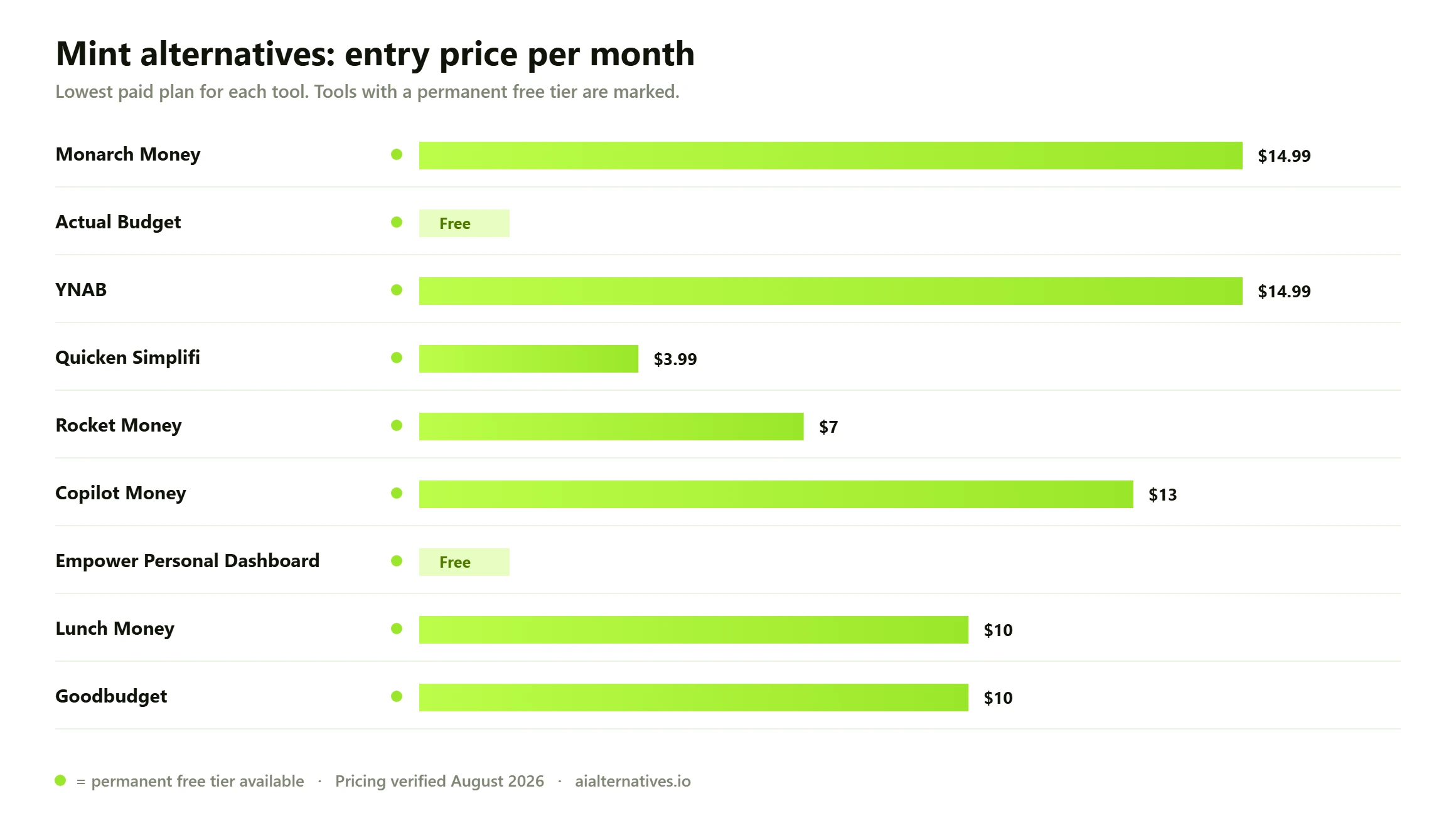
Entry monthly price across every Mint alternative we tested. Green dot marks a permanent free tier. Pricing verified August 2026.
Why people are leaving Mint (and why Credit Karma didn’t fix it)
Intuit announced Mint’s closure on October 31, 2023, originally targeting the end of that year. It then pushed the final date to March 23, 2024, which is probably the date you remember.
Mint’s own founder, Aaron Patzer, said the product had been in maintenance mode for about eight years. That probably matches what you saw yourself: broken bank connections, stale categories, and ads stapled to everything.
The Credit Karma migration disappointed almost everyone
Intuit pushed you toward Credit Karma, its other free property. The migration carried over your linked accounts, supported transactions and net worth history. What it didn’t carry over was your budgets, because Credit Karma has no real budgeting feature.
Intuit said as much at the time, admitting Credit Karma did not provide budgeting the way Mint had. Users also lost transaction splitting, custom category names, and readable merchant renaming. Investment balances show the previous day’s numbers, not live ones.
That gap is probably the whole reason you’re here. Credit Karma is a fine free credit-score and net-worth tool for you to use. It just isn’t a budgeting app.
Mint alternatives compared: price, free plans and bank syncing
Tool
Best for
Starting price
Free plan
Monarch Money
Best overall Mint replacement
$99.99 per yr ($14.99 per mo)
No, 7-day trial
Actual Budget
Best genuinely free option
Free, open source
Yes, fully free
YNAB
Best for breaking paycheck cycles
$109 per yr ($14.99 per mo)
No, 34-day trial
Quicken Simplifi
Cheapest full-featured tracker
From $3.99 per mo, billed annually
No
Rocket Money
Best free tier with bank sync
Free / $7-$14 per mo
Yes, limited budgets
Copilot Money
Best design, Apple only
$95 per yr ($13 per mo)
No, 1-month trial
Empower Personal Dashboard
Free net worth and investing view
Free
Yes, fully free
Lunch Money
Expats and multi-currency
$100 per yr ($10 per mo)
No, 30-day trial
Goodbudget
Budgeting without bank logins
Free / $80 per yr
Yes, 10 envelopes
One thing every synced app shares: none of them talk to your bank directly. They rent connections from Plaid, MX, Finicity or Akahu. When your bank changes its login flow, every app on this list breaks at roughly the same time.
The best alternatives to Mint, reviewed
1. Monarch Money — the default Mint replacement
Monarch does what Mint did for you, then keeps going. You get custom categories, rules, goals, net worth tracking, investment holdings and cash-flow reports all in one place. Partner or advisor access comes included, not as an upsell.
What it lacks is speed. Redditors consistently flag slow syncs and occasional miscategorization, so don’t expect instant updates. It’ll cost you $14.99 per month, or $99.99 per year on the Core plan, with a Plus tier at $199 per year. You get a 7-day trial to test it.
2. Actual Budget — the free, open-source pick
Actual is the honest answer if you’re searching for a free Mint alternative. It’s open source, local-first, and free for you to run on your own machine or a cheap hosted pod. Nothing here is ad-supported, because there’s no company monetizing you.
The catch is bank syncing. Actual connects through third parties, and the US option, SimpleFIN, costs $1.50 a month or $15 a year. GoCardless covers the EU and UK. You can also skip syncing entirely and import CSVs.
3. YNAB — the method, not just the app
YNAB makes you assign every dollar a job before you spend it. It’s the only app here that reliably changes your behavior rather than just reporting on it. Just know reports and net worth tracking are thinner than what you’d get with Monarch.
It’s also the priciest option you’ll find here: $14.99 per month or $109 per year, with no permanent free plan. The 34-day trial needs no card from you, and if you’re a verified college student you get a free year.
4. Quicken Simplifi — the value play
Simplifi is the one to try if $100 a year feels steep to you. It runs from $3.99 per month billed annually, up from a $6.99 list price, and covers your spending plans, bill tracking, savings goals and investment monitoring.
Read the fine print before you commit: the discounted annual rate applies to your first year only, then renews at the standard rate. There’s no free tier and no permanent free trial.
5. Rocket Money — the free tier that actually syncs
Rocket Money’s free plan links your checking, savings, credit cards and investments, tracks your spending, and finds subscriptions you’ve forgotten about. Budgeting is capped at two custom categories, which is the nudge that pushes you toward Premium.
Premium is pay-what-you-think-is-fair, typically $7 to $14 a month. Be aware of the bill negotiation fee before you agree to it: if Rocket Money lowers a bill for you, it keeps 35% to 60% of your first year of savings.
6. Copilot Money — the one that looks best
Copilot gives you the sharpest interface in personal finance, with fast auto-categorization and clean recurring-expense views. If you use Apple Card, Venmo or Amazon, those integrations are a genuine edge for you.
The dealbreaker hasn’t moved: as of August 2026 Copilot ships for iPhone, iPad, Mac and web, with no Android app, so check your phone before you get excited. Pricing runs $13 per month or $95 per year after a one-month trial.
Free Mint alternatives that are actually free
Most “free” lists you’ll come across are counting trials as free. Here’s the honest split, as of August 2026, so you know what you’re actually getting.
Actually free, forever: Actual Budget, Empower Personal Dashboard, Credit Karma, and Goodbudget’s capped free plan — no trial required.
Free tier with real limits: Rocket Money, which syncs your banks for free but caps custom budgets at two.
Free trial only: Monarch, YNAB, Copilot, Simplifi, Lunch Money and PocketGuard — after that, you’re paying.
The trade-off you’re making is consistent. Free tools either take payment in your data and ads, like Credit Karma, or in your time, like self-hosting Actual yourself. Nobody is giving away Plaid connections at scale anymore, which is exactly why Mint died in the first place.
Availability outside the US
This matters more than most guides admit, especially if you’re outside the US. Monarch, Rocket Money, Simplifi, Copilot and Empower are effectively US-focused, so check before you sign up. Lunch Money and Actual Budget handle multiple currencies and non-US banks properly. YNAB syncs in the US, Canada and parts of Europe. Goodbudget works anywhere you are, since manual entry doesn’t care about borders.
How to choose the right Mint alternative
Pick based on the job you actually need done, not the longest feature list.
You want Mint back, more or less. Monarch Money. It’s the direct successor in shape and scope, and the sharing feature makes it the obvious choice for couples.
You want to spend nothing. Try Actual Budget if you’re comfortable with a little setup, or Empower if you mostly want net worth and investment tracking with zero effort from you.
You keep overspending. Try YNAB. The cost is annoying, but the method works. Give it a full 34-day trial before you judge it.
You’re price-sensitive but want automation. Quicken Simplifi gets you there at under $4 a month — just keep an eye on the year-two renewal price.
You have subscriptions you’ve forgotten about. Run Rocket Money’s free tier, at least to do the audit yourself.
You don’t want to hand over your bank logins. Use Goodbudget or Actual with manual import instead.
Is switching worth it?
Yes, if you were using Mint to actually budget. Credit Karma can’t do that job for you, and no amount of waiting will change it. Monarch, YNAB or Simplifi will all beat what Mint offered you back in 2023, because Mint had barely been updated since 2016.
It’s less clear-cut if you only used Mint to glance at your balances. Credit Karma and Empower will both do that for you for free, and paying $100 a year for a dashboard you check twice a month is hard to justify.
When to stay put
If you already migrated to Credit Karma and only track your net worth and credit score, just stay put. If you built a working spreadsheet after the shutdown, stay there too. Spreadsheets don’t raise prices or get acquired out from under you.
One practical warning before you commit to anything: export your data early and often. Mint users who waited past March 23, 2024 lost access to years of transaction history for good. Every app here supports CSV export, so use it quarterly and keep your own copy.
Questions
Mint alternatives FAQs
The questions people actually ask on Google, Reddit and Quora — answered with what we verified this month.
Intuit announced on October 31, 2023 that it was shutting Mint down, and the app closed for good on March 23, 2024. If you were a user, you were migrated to Credit Karma, another Intuit product. Your linked accounts, supported transactions and net worth history transferred over, but your budgets did not.
02 Is Credit Karma a good replacement for Mint?
Only if you never really used Mint’s budgeting tools. Credit Karma tracks your net worth, credit score and spending categories for free, but it has no real budgeting feature, no transaction splitting and no custom category names. If you need actual budgeting, Monarch Money, YNAB or Quicken Simplifi are far closer replacements for you.
03 Is there a free Mint alternative that syncs with my bank?
Two are worth knowing about. Rocket Money’s free plan links your bank accounts and tracks your spending, though it caps custom budget categories at two. Actual Budget is free and open source, but if you’re in the US, bank syncing runs through SimpleFIN at about $15 a year, or you can import CSVs yourself for nothing.
04 Why do most Mint alternatives cost money now?
Because bank connections cost real money. Apps license data through providers like Plaid, MX and Finicity, and those per-account fees scale with users like you. Mint offset that cost with ads and lead generation, which stopped working well enough for Intuit to keep it alive.
05 What is the cheapest paid Mint alternative?
Quicken Simplifi is your cheapest option, at around $3.99 per month billed annually as of August 2026, versus a $6.99 monthly list price. Just note that the discounted rate applies to your first year only. Goodbudget Plus is $80 a year if envelope budgeting works for you.
06 Can I still get my old Mint data back?
No. Mint stopped operating on March 23, 2024, and the export window closed right along with it. If you migrated to Credit Karma before then, some of your transaction history and net worth data may still be sitting in that account. Otherwise, the only copies left are CSVs you downloaded yourself.
Updated monthly · No paid placements
Still comparing?
See how the top picks square off head to head, or browse every alternative guide we publish.